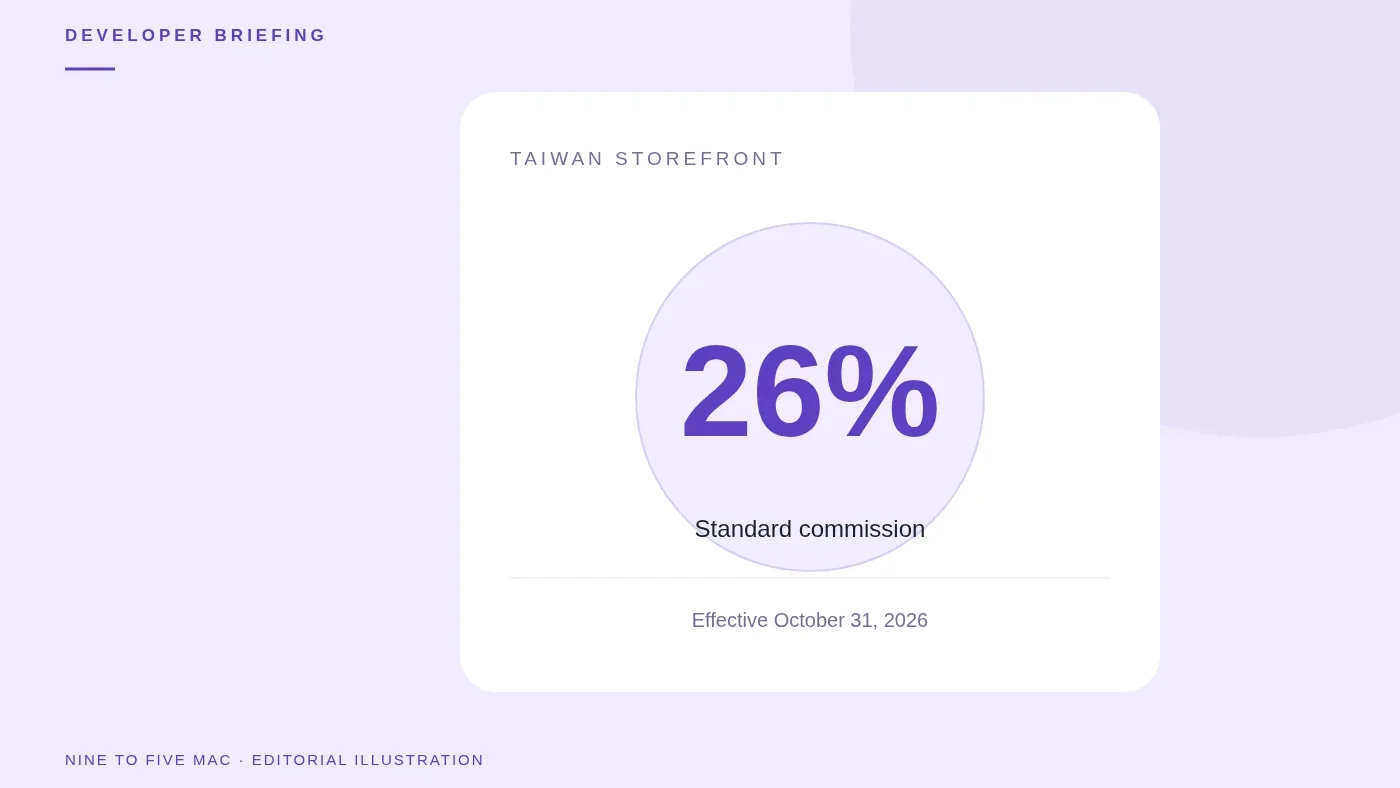
Apple has reduced the standard commission rate for paid apps and Apple In-App Purchase transactions on the Taiwan App Store storefront for iOS and iPadOS. The company’s October 29 notice says the rate changed from 30% to 26% on October 31, 2026, following discussions with the Taiwan Fair Trade Commission.
Apple also says developers did not need to sign the revised terms by October 31 to receive the benefit from that date. The Developer Program License Agreement has been updated, and the notice directs account holders to review and accept the new terms through their accounts.
Keep the scope attached to the number
This is a change to the standard rate for the named storefront, platforms, and transaction types. It should not be turned into a claim that Apple has adopted a 26% commission worldwide or that every developer transaction now carries that rate.
That distinction is useful when discussing revenue with colleagues or customers. A short headline can lose its conditions as it moves through a presentation, a spreadsheet, or a social post. Keep the market, effective date, and applicable transaction category on the same line as the percentage.
A simple calculation, with clear assumptions
To illustrate the arithmetic only, imagine a commission base of 100 units. A 30% commission would leave 70 units before other applicable deductions; a 26% commission would leave 74. The difference is four units, or four percentage points of that assumed base.
This is not an estimate of a particular app’s payout. Actual proceeds depend on the relevant agreement, transaction details, tax treatment, and any applicable program or adjustment. The example deliberately does not assume a currency, a subscription mix, or eligibility for a separate arrangement.
The practical lesson is to distinguish a rate change from a revenue forecast. A forecast needs the app’s own data and the correct rules for each transaction, not simply the new percentage multiplied by total global sales.
Review reports before changing plans
Our suggested operational response is a focused reconciliation. Identify the affected storefront in the team’s reporting, separate the transaction categories being examined, and compare the expected treatment with the relevant account records when those records are available.
Record which dates and reports are being compared. If a difference appears, preserve the transaction context and ask the appropriate platform support or professional adviser rather than assuming that the headline rate explains every variation. Avoid changing unrelated assumptions while investigating one specific adjustment.
Account owners should also make sure the revised agreement reaches the person responsible for reviewing it. A business benefit taking effect without a signature by a particular date does not remove the need to understand the current terms governing the account.
What it means for customers
A lower commission does not establish a new retail price for an app or subscription. The notice does not promise that developers will pass the difference directly to customers, and it does not identify how any individual business will use the change.
Developers may evaluate their own pricing, investment, or operating choices, but those are separate decisions. Readers should check an app’s actual storefront price and renewal terms rather than inferring a discount from a commission announcement.
This article reports Apple’s published notice and offers a framework for reading its scope. It is not a legal interpretation of an individual agreement or a personalized calculation of developer proceeds. The source announcement and current agreement are linked for readers who need to investigate the applicable terms further.
Sources & further reading
Source material checked November 5, 2026. Availability and software features can change.
Written with AI assistance, checked against the sources linked above, and reviewed by our editorial desk. Analysis reflects our interpretation; product coverage does not imply hands-on testing. How we work